Long-form Questionnaire Results
Lucerne Questionnaire (validated) on Psychological Safety with 15 questions
Psychological safety value for the team
Psychological Safety – Action Areas
Recommendations
According to Google's Aristotle Study, psychological safety is the strongest predictor of team performance. How close are these values in your team?
For orientation: The values are close together (6 points difference)
Normal Case: Matching Values
The values for psychological safety and performance are close together. The dynamics are consistent – interventions can target the overall system.
For values between 75 and 85, a next moderated step would be possible to strengthen psychologically safe circles.
1. Action areas & matching training settings
Invitation for the team: Prioritize three settings from the action areas and work through them together as a team over the coming weeks.
61
199
Median
Average
Social sensitivity: Everyone in the team is willing and able to perceive what gives the other person security and what might be trigger topics.
Setting 11: Picture exercise at the crossroads
Preparation: Bring a picture to the workshop that helps others understand what your safety anchor is. Ideally it even shows you at an important crossroads in your life where things could have gone either way—a moment when you chose a direction professionally, in family life, or personally, and felt inner uncertainty or even fear.
Time: sixty minutes (five minutes introduction, forty-five minutes in triads, ten minutes debrief)
Note: The picture exercise also works in a town-hall setting with many participants to convey how a psychologically safe circle can feel. It anchors a positive experience through honest encounters in triads that people can connect to later in daily life.
Short instructions:
- Five minutes: Show the picture and listen: What do partners see? Who and what does the picture show at which crossroads? When was it taken? Mode: free association, exaggeration, take risks.
- Five minutes: The owner dissolves projections—what actually happened?
- Five minutes in dialogue: What gives you safety, and what triggers you or sometimes even evokes fear?
Plenary briefing (five minutes): Walk briefly through the slide. You may ask participants to photograph it and take responsibility for timeboxing so everyone gets equal voice. The goal—the deliverable—is to trace each person’s safety anchor and related trigger theme.
Plenary debrief (ten minutes):
1. How was this setting for you—what did it evoke?
2. How might this sequence relate to our topic of psychological safety?
3. Did you notice the moment when you consciously decided: I will share this, not that?
---
Setting 12: LOVE, WISH and SUPPORT – group feedback
In building psychological safety, feedback is a helpful tool—when it is respectful and supportive. One of my favourite formats is LOVE/WISH/SUPPORT.
Preparation and opening: A circle of chairs works best. Each person gets a sheet of A3 divided vertically into three equal columns. Everyone writes their name at the top and the headings LOVE, WISH, and SUPPORT. Sheets travel around the circle and collect feedback from others.
Time: forty-five minutes for a group of ten (five minutes intro, three minutes feedback per person, five minutes to read, five minutes debrief). Suitable up to about fifteen people.
Post a short explanation of the three columns on a flip chart:
1. LOVE: I especially appreciate your contribution to how we work together when WE …
2. WISH: You could strengthen psychological safety in the team if YOU …
3. SUPPORT: I will support you in making our team psychologically safer by I …
The feedback round: Everyone passes their sheet to the left neighbour. The receiver looks at the name at the top and writes at the bottom of the sheet, column by column, quickly and associatively without overthinking. After writing, fold the contribution to the back so it stays confidential—only for the recipient. The sheet moves left again until everyone has given feedback to everyone.
Closing reflection: When sheets return, each person has full individual feedback from all colleagues. Reading takes about five minutes. Use the circle to reflect together: What feelings came up while reading? What surprised you? What will you take with you?
---
Setting 13: Measuring social sensitivity with the “Well Quiz”
The Well Quiz is a tool for measuring social sensitivity, reportedly used by Google in Project Aristotle. Google identified average social sensitivity as one of two key items to operationalize psychological safety in teams.
Goal: Results provide a scale for how well someone reads emotions and subtle social cues.
Sample task: Participants see a picture of eyes and judge whether the expression is thoughtful, worried, joyful, or startled.
Practical use in teams:
- Individual: People take the quiz to assess their social sensitivity as input for reflection and growth.
- Team diagnosis: Team averages hint at how well the group reads emotional signals and how much potential for psychological safety exists.
- Training: Insights can shape targeted training such as empathy exercises or nonverbal communication workshops.
---
Setting 25: Online Safecircle analysis
The first stage of the challenge takes ninety minutes and suits groups of three to fifteen. Access is on this results page.
The “Safecircle analysis” combines all three approaches to psychological safety: you can measure it, talk about it, and experience it. Three areas sit at the centre:
1. Social sensitivity – naming shared safety anchors and triggers: Explore what gives us safety and where our triggers lie. Share anchors, build sensitivity to triggers, and open different perceptions of sources of psychological safety in the team.
2. Reality check – seeing your contribution to psychological safety: Reflect on your influence on team climate while others listen to your assessment. How do I already contribute? Where are blind spots or tensions?
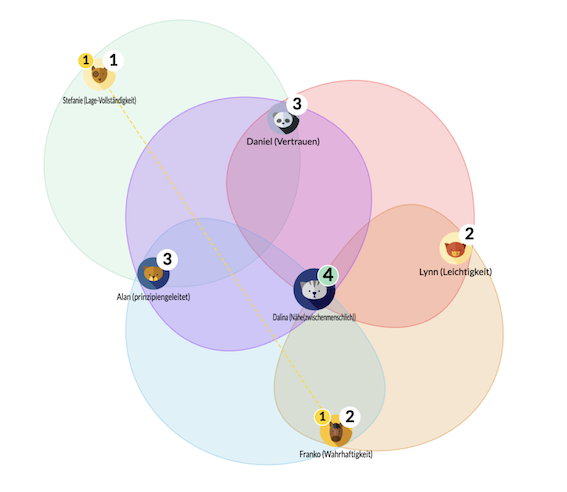
3. Safe circles – boosting safe circles in the team: The analysis produces a consolidated map of psychologically safe circles potentially available in the team. The goal is to strengthen integrators, bring satellites in, and increase the centrality of leadership.
---
71
199
Median
Average
I don't find it difficult to ask others in the team for help.
Setting 17: LS Troika Consulting – peer consulting with a reflecting team
Then the process starts: I present my issue. What is on my mind? What exactly is my challenge (two to three minutes)?
My reflecting team asks clarifying questions—short, precise (one to three minutes).
Then I turn away, avoid eye contact and any verbal or nonverbal feedback. I step out of the conversation mentally, only listen and take notes. The other two work for me: they talk about my topic as if I were not in the room—sharing sensations and body reactions, developing ideas and impulses freely, associatively, honestly—never as direct advice (four to five minutes).
Closing happens eye to eye in the trio: I share what mattered to me, what touched me, what I take away (two minutes).
Then roles rotate. So that all three issues get attention within forty-five minutes, each person is in focus for fifteen minutes.
---
Setting 22: LS What I Need From You
With this Liberating Structure you invite the team to name elephants in the room and snakes under the carpet—concretely regarding your behaviour as a leader. WINFY works in small teams and in town halls with hundreds of people.
Step 1 – Check-in (five minutes): Ask the team what you can concretely do to improve psychological safety here. Your stance: I am here to listen carefully. No explaining or defending.
Step 2 – Appreciation (ten minutes): First ask for a round of appreciation. Each person in turn shares a moment that touched them and a situation where you already contributed well to psychological safety.
Step 3 – Make needs visible (fifteen minutes): Without your input the team uses 1-2-4-All to collect behaviours they need from you as a leader. Before you leave the room invite clear formulations along the line: “What I need from you is …”
Step 4 – Straight question, straight answer (fifteen minutes): You return and a facilitator reads the collected needs one by one. You listen, repeat the point, and respond with one of four options:
- Yes (I will take this need on board and meet it).
- No (I will not meet this need).
- I will try (I heard you and commit to working on my behaviour).
- I do not understand (Please phrase the need more clearly).
Explanations, justifications, or discussion are not allowed. As a sign of appreciation a “joker” may allow up to one minute of clarification for one chosen answer.
Step 5 – Check-out (fifteen minutes): The gaze turns outward: the team takes shared responsibility. Each person states how they can support you as a leader in putting the named behaviours into practice.
---
Setting 25: Online Safecircle analysis
The first stage of the challenge takes ninety minutes and suits groups of three to fifteen. Access is on this results page.
The “Safecircle analysis” combines all three approaches to psychological safety: you can measure it, talk about it, and experience it. Three areas sit at the centre:
1. Social sensitivity – naming shared safety anchors and triggers: Explore what gives us safety and where our triggers lie. Share anchors, build sensitivity to triggers, and open different perceptions of sources of psychological safety in the team.
2. Reality check – seeing your contribution to psychological safety: Reflect on your influence on team climate while others listen to your assessment. How do I already contribute? Where are blind spots or tensions?
3. Safe circles – boosting safe circles in the team: The analysis produces a consolidated map of psychologically safe circles potentially available in the team. The goal is to strengthen integrators, bring satellites in, and increase the centrality of leadership.
---
71
199
Median
Average
Evenly distributed speaking time: Everyone in the team can expect to speak about equally often and at length.
Setting 14: Blind counting to twenty
Suitable for groups of five to fifteen.
This icebreaker fits well after lunch to make the positive effect of social sensitivity and balanced speaking time tangible.
Stand in a circle with eyes closed. Someone says “one”, someone else—without planning—says “two”, and so on until the group reaches twenty together. (Advanced groups can count back down.) Everyone is invited to participate equally.
If two people say the same number at once, start again from one until you succeed. The group learns to attune and usually develops a calm, mindful tone—a good basis for mastering the challenge.
Source: Bleß and Wagner (2022)
---
Setting 15: Check-in
Whenever possible I work in a circle of chairs and start sessions with a check-in. Everyone speaks once in turn without interruption. I invite people to take thirty to sixty seconds each on how they are arriving and what they expect—passing is always allowed.
As a metaphor for mood I sometimes offer a “weather report” so everyone can see how people are arriving. In mature groups I let participants choose order; if I do not yet know the group I ask a volunteer to start and then go around the circle.
In larger groups of more than twelve I sometimes run check-ins as speed dating or Liberating Structures Impromptu Networking—several rounds of sixty-second pairs.
Helpful check-in questions for our topic:
- What do you already know about psychological safety?
- What interests you most about our topic today?
- How would you know it was worth giving this topic your time and attention today?
---
Setting 16: LS 1-2-4-All
1-2-4-All is a classic Liberating Structure for reliable drama-free collaboration. The whole flow fits in fifteen minutes and is an excellent alternative to endless plenary discussion. It is fast, clear, energizing, and surprisingly deep—many perspectives appear and every voice gets space.
Phase 1 – ONE (one minute): Each person reflects alone—no distraction, no exchange. Just pen, paper, and your own thinking.
Phase 2 – TWO (two minutes): Pair up. For two minutes share your thoughts and build first ideas together.
Phase 3 – FOUR (four minutes): Two pairs join into a foursome. In four minutes discuss which proposals from the exchange seem most viable.
Phase 4 – ALL (eight minutes): Groups report to plenary—about ninety seconds each. You quickly get a broad picture—and every voice had room along the way.
---
Setting 17: LS Troika Consulting – peer consulting with a reflecting team
Then the process starts: I present my issue. What is on my mind? What exactly is my challenge (two to three minutes)?
My reflecting team asks clarifying questions—short, precise (one to three minutes).
Then I turn away, avoid eye contact and any verbal or nonverbal feedback. I step out of the conversation mentally, only listen and take notes. The other two work for me: they talk about my topic as if I were not in the room—sharing sensations and body reactions, developing ideas and impulses freely, associatively, honestly—never as direct advice (four to five minutes).
Closing happens eye to eye in the trio: I share what mattered to me, what touched me, what I take away (two minutes).
Then roles rotate. So that all three issues get attention within forty-five minutes, each person is in focus for fifteen minutes.
---
Setting 18: LS Fifteen percent solutions check-out
I like the Liberating Structure “Fifteen percent solutions” for check-out and closing. Inspired by the line that each of us is only one pixel but together we make the picture, a minimal behaviour change—a baby step per person—can shift group climate. Everyone reviews the workshop and notes privately for two minutes: What can I do from tomorrow onward—without extra resources or permission—to contribute more psychological safety?
In the closing round everyone can expect uninterrupted time to share their commitment. In mature groups I let participants choose order. The second-to-last word goes to leadership: finding the right words and stating their commitment to support our process toward more safety. I take the last word to compliment the team on the work done and share what touched me.
---
Setting 19: Talking cards
A simple and effective way to ensure everyone on the team gets to speak is talking cards. At the start of the meeting each participant receives a card. Anyone who wants to speak places their card visibly on the table. Only when all cards have been played are they redistributed to the team—so everyone speaks at least once before anyone speaks again.
To make the method more playful, cards can show different animals. Each new round everyone gets a different animal card—this lightens the exercise and adds reflection: How does an owl communicate compared with a lion? Is the team more elephants or chameleons right now?
The method fosters deliberate speaking and listening, prevents one-sided dominance, and supports balanced discussion. Especially when some people talk a lot and others hold back, talking cards strengthen psychological safety and improve team communication quality.
---
Setting 20: Tally of speaking contributions
A tally is a simple way to make speaking time visible. During a discussion or meeting each contribution by a person gets a tick. The visual pattern quickly shows imbalance and raises awareness of airtime.
At the end of the meeting the team briefly reflects:
- How close are we to balanced speaking time—Google’s indicator for psychologically safer teams?
- What effect do current speaking patterns have on our performance and learning quality?
- What could support more balanced participation?
Source: Psych Safety Training DE, programme to increase psychological safety in teams, developed by Carmen Kobe, Ina Goller et al.
---
Setting 21: Timeboxing
Core idea: Timeboxing belongs in every agenda or script: each agenda item gets a defined duration and a clear focus. For complex topics clarify in advance what would show that time was well spent.
Facilitation practice:
1. Fixed time windows: Depending on topic and group size, set limits per contribution or theme.
2. Visible timer: Timer or traffic-light signals make airtime transparent. A gentle sound or visual cue signals the end of a slot.
3. Flexibility when needed: If a topic needs more time, the group can consciously decide to extend or park it.
4. Review: Briefly at the end of a meeting check whether everyone was heard and how timeboxing affected conversation quality.
Timeboxing also prevents a few topics or people from dominating. Timekeeping—the role of guarding the script—can rotate usefully from session to session.
Setting 25: Online Safecircle analysis
The first stage of the challenge takes ninety minutes and suits groups of three to fifteen. Access is on this results page.
The “Safecircle analysis” combines all three approaches to psychological safety: you can measure it, talk about it, and experience it. Three areas sit at the centre:
1. Social sensitivity – naming shared safety anchors and triggers: Explore what gives us safety and where our triggers lie. Share anchors, build sensitivity to triggers, and open different perceptions of sources of psychological safety in the team.
2. Reality check – seeing your contribution to psychological safety: Reflect on your influence on team climate while others listen to your assessment. How do I already contribute? Where are blind spots or tensions?
3. Safe circles – boosting safe circles in the team: The analysis produces a consolidated map of psychologically safe circles potentially available in the team. The goal is to strengthen integrators, bring satellites in, and increase the centrality of leadership.
---
Show more items
72
199
Median
Average
I rarely observe how people are excluded from the team.
74
199
Median
Average
For me, everyone in the team is always clearly visible.
79
199
Median
Average
One rarely responds to mistakes by blaming individual team members.
79
199
Median
Average
I feel how my talents are seen and included in the team.
83
199
Median
Average
Voice: We work together in a trusting atmosphere in which all team members can contribute openly and without fear.
88
199
Median
Average
Elephants in the room: We can look at difficult topics together well.
2. Contribution to psychological safety
What can you do starting tomorrow – without additional resources or permission – to contribute to more psychological safety?
Try the three highlighted baby steps for one month as a team. Then: What helped? What didn't?
In meetings, explicitly ask: Who have we not heard from yet?
Schwierige Themen zu Beginn der Agenda fest einplanen.
After mistakes, learn first, then solve – without blaming.
Brief Monday check-in: What do you need to feel safe this week?
Briefly check team mood before decisions.
Express praise and recognition deliberately – even for small contributions.
3. Cheat sheet for social sensitivity
Checkout suggestion – share your safety anchors and triggers once, in turn.
Entries are anonymous by default («Participant 1», «Participant 2», etc.). Anyone who optionally provided an email address is shown with a name derived from it.

When we clarify priorities calmly and have enough time to think.
Unannounced deadlines or public criticism without warning in meetings.
When opinions are shared openly and follow-up questions are explicitly welcome.
When important decisions are made behind closed doors.
When agreements are kept and we can rely on each other.
When commitments are postponed or information arrives incomplete.
When I can decide for myself how to approach my tasks meaningfully.
When I constantly have to ask for permission before I can act.
When we interact personally as equals and with appreciation.
When mockery or sarcastic remarks become normal in the team.
When we work in a focused way and avoid unnecessary detours together.
When details are overlooked and mistakes happen through haste.
4. Agency
74
199
Median
Average
Inner safety: I feel safe in this team.
79
199
Median
Average
I try to make an effective, positive contribution to psychological safety in our team.
5. Team Performance
81
199
Median
Average
How well do you use your potential when working together?
Bonus for Statistics Nerds: Team Metrics
Calculated Values
Status: Not aggregatable
Insufficient agreement for reliable aggregation
Visual Classification of Values
Meaning of the Values
ICC(1) – Proportion of Variance Due to Team Membership
ICC(1) shows how much of the individual variance is explained by team membership. A high value means that teams differ significantly from each other.
- ≥ 0.20: High – Teams differ clearly from each other
- 0.10-0.20: Moderate – Moderate differences between teams
- < 0.10: Low – Low team differences
ICC(2) – Reliability of Team Means
ICC(2) measures the reliability of team means. A high value means that team means are stable and reliable.
- ≥ 0.80: Very high – Team means are very reliable
- 0.60-0.80: High – Team means are reliable
- < 0.60: Moderate/Low – Team means are less reliable
rwg(j) – Agreement Among Team Members
rwg(j) measures how much team members agree in their perception. A high value means that team members have a shared perception and aggregation at the team level is justified.
- ≥ 0.70: High – Team members largely agree, aggregation recommended
- 0.50-0.70: Moderate – Partial agreement, aggregation possible
- < 0.50: Low – Perceptions strongly differ, aggregation not meaningful